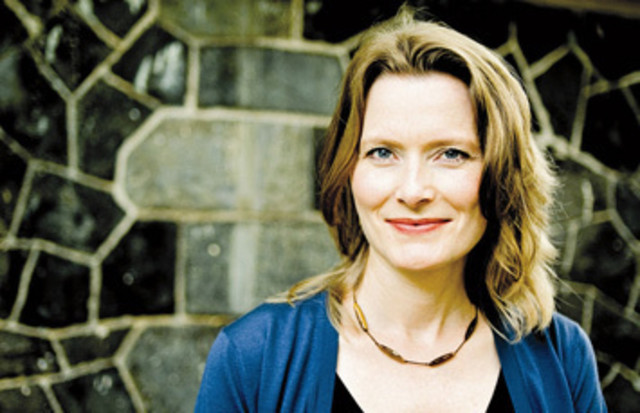
Jennifer Egan.
Jennifer Egan talks writing by hand, the future of books, music journalism, old address books, shoplifting and her Pulitzer Prize-winning novel, A Visit from the Goon Squad.
By Shawn Conner.
I first met Jennifer Egan a year or two before this interview, at a library in Brooklyn. I was visiting New York and, while looking through a local paper’s entertainment listings, noticed that she was giving a reading.
Being a fan of her novel The Keep, I took the subway out of Manhattan to the library, where Egan was holding court for me and a small group of mostly retired folks. Afterwards, she graciously signed my copies of The Keep and her earlier novel The Invisible Circus. It remains one of my favourite author-meeting experiences.
Last month, Egan’s novel A Visit from the Goon Squad won the Pulitzer Prize for Fiction, the latest in a growing list of accolades that also includes the 2011 National Book Critics Circle Award.
A Visit from the Goon Squad is remarkable for its stylistic experiments—one chapter takes the form of a PowerPoint presentation—as well as for its story and prose.
Set in and around the music business, the book revisits themes from Egan’s earlier work: the American girl lost or missing in Europe, celebrity and celebrity culture, and the ways technology changes our relationships with one another.
The threads intertwine in a nonlinear structure. Each chapter works as a story in its own right, with minor characters in one section sometimes taking centre stage in another. Settings and decades shift as Goon Squad moves from San Francisco’s nascent punk-rock scene to an African safari to a future New York City concert. It’s not quite a conventional novel or a collection of short stories; at times it feels more like a concept album.
In 2010, shortly after the book’s publication, I reached Egan at home in Fort Greene, Brooklyn. We talked about writing in coffee shops, books and technology, old address books, shoplifting, music journalism, Jägermeister and the future of reading.
Writing in coffee shops
Shawn Conner: I don’t imagine you see many bands these days.
Jennifer Egan: Not as a resolution, but it doesn’t fit into my life too much at this point. It doesn’t seem to happen all that often.
SC: How close is Fort Greene to Williamsburg? Because you can’t swing a dead cat in Williamsburg without hitting a musician.
JE: It’s pretty close! And you can’t swing a dead cat in our neighbourhood without hitting a writer. Oh my God, it’s lousy with writers.
SC: So when you go to a coffee shop, everyone’s on their Macs writing short stories.
JE: I don’t know. I try not to go to coffee shops where writers appear to be writing.
SC: Do you like to write in coffee shops?
JE: I actually do like to write in coffee shops. I like to drink coffee when I write, which is part of it. I’m not a regular anywhere. I’ll sit down and see if the moment is right.
I’m not a fixture at any coffee shops, but I’ve certainly darkened the doorway of many in Brooklyn over the years. Because I have little kids, I do end up out more than I used to. I used to spend whole days and barely leave my apartment.
Sometimes I just find my office is a really uninspiring place to be. Often it’s kind of messy and I’m full of guilt about all the things I haven’t done. Going out is a quick way to clear the decks and create a fresh feeling.
Writing—and reading—methods
SC: And you write in longhand.
JE: Of course, I use the computer as a typing machine. But I edit longhand on hard copy and then type in my changes. As a journalist, I write everything on a computer.
For fiction, I find having my impulses and sentences staring back at me in typeface right away very inhibiting, and it seems to lead me backwards rather than forwards. It really hinders my method, which is unconscious outpouring initially, followed by methodical analysis and instruction-making.
But I can’t get the material to work with if I don’t feel comfortable letting it rip.
SC: What about reading?
JE: I hate reading on a computer. It actually hurts my eyes. Maybe it’s not bad to be on an electronic device all day—I realize studies have shown it has no impact at all—but it doesn’t feel healthy to me. I don’t like being attached to a machine all day.
You should never say never. In five years maybe I’ll laugh about this. But I can no more imagine choosing to read a book on a screen rather than an actual book. It almost feels like a step backwards to me. You’re relying on electronics. You can’t read it as your plane is taking off—why? Why would anyone want to do that?
At the same time, I’m a little disingenuous when I say that, because I deeply understand people want to do it, and I’m fascinated by those impulses. And curious about them.
“I still have my old address book”
SC: We’re also the generation that worships books as objects.
JE: I believe in objects. I like objects. I’m not a fetishist about them; I don’t collect antiques or stamps. But I actually like things sometimes.
This idea that everything can exist and not exist, and be more efficient and more flexible, to me is strange. What you lose is all the traces of yourself and your past.
For example, I still have my old address book. It’s very cumbersome, and I can definitely see why, when and if—I’m sure eventually I will—I end up having all this in a handheld device, I’ll just laugh that I hauled around this kind of chunky, slightly dilapidated book.
But what I like about it is that every time someone moves or gets divorced or dies, I still have all of their information there. It’s like a palimpsest of the past that shines up through the present.
Even when I change people’s addresses in my address book, I cut a little sticker to fit over the old address and put the new one on. So there’s a kind of layering. I like that. I used to want to be an archaeologist. Maybe this is where I can’t seem to let that go.
It’s a little bit the reason I like to write by hand, too. If you’re always writing and editing on a screen, there’s no sense of history there. You’re existing in a continuous present. I like having the traces.
I can look back through these drafts and find the chain of decisions that led me from the very start on yellow legal pads to what I ended up with. I like having that sense of connection.
Shoplifting for experience
SC: That’s the first time someone I’ve interviewed has used the word “palimpsest.”
JE: It’s so strange. I’ve done more interviews in the last few weeks than I have in my life, and this is the first time this—the importance of objects—has come up. And I think about it a lot.
SC: Sasha, one of the characters, is a kleptomaniac. Did you ever shoplift?
JE: I did a little bit, with my friends, but I was terrified. There was no thrill. I’m a very law-abiding sort of Catholic schoolgirl, and it was terrifying to me to think about getting caught.
As a result, I was terrible at it. The ones who did a much better job were the ones who did get a kind of thrill from it and didn’t have any guilt about it. What I remember was feeling jealous of the girls who had more guts and could take more.
SC: But that’s the writer’s role. It sounds as though that was your role during your punk-rock phase as well.
JE: It’s always been my role. I’m so glad I found a job that makes it okay to be like a loser-outsider. [Laughs.] Now I can say, “Hey, there was a strategy all along. It’s okay I was this totally forgettable non-entity. I was being a writer!”
SC: Then again, that’s your take on it. Someone else in the scene might have seen it otherwise.
JE: I think that I’m right about that in these contexts. I was an okay character as a teenager. I didn’t have one of those strong teenage personalities that leave a mark. I was quiet and hesitant and watchful and generally a follower.
Celebrity and music journalism
SC: In A Visit from the Goon Squad, you get to indulge in a couple of different types of journalism, celebrity and music. How did you approach describing music?
JE: I have done almost no music journalism, and that may be one reason I didn’t feel fatigued by the attempt. Although I was conscious of the fact that language was not always working with me in that effort.
I thought about reading descriptions of wine. I could feel this strained effort on the part of the writer to come up with some exciting adjectives that hadn’t been used in connection with wine before. I felt that a little bit. It was not easy.
The danger is that it sounds incredibly clichéd. The minute a word is uttered, it feels wrong. But in the end I felt satisfied with it.
In a way, maybe everyone gets to do that happily once. It’s got to get a lot harder the more times you do it.
SC: One of the lines I like is, “Everybody sounds stoned, because they’re emailing people the whole time they’re talking to you.”
JE: Isn’t it true! I can’t talk to my husband. He’s incapable of not emailing while we’re on the telephone. It’s like we’re talking 20 years ago long-distance. There’s a time lapse: “Hello, are you there?”
And sometimes on a conference call it’s bizarre. Everyone seems to be in that space because no one’s owning the conversation. And you can even hear people typing.
SC: Another line I loved is when one character says of his son, “He didn’t make it.” It’s only four words, but they say so much.
JE: That’s all Lou can say. That’s the only way he can actually frame what occurred, which is unspeakable. And his speech is so impaired at that point. It’s this tiny little offering.
Why Jägermeister?
SC: Why did you make the washed-up musician Scotty’s drink of choice Jägermeister?
JE: I never have good answers to those kinds of questions. But I have an anecdote.
When I went to my stepsister’s wedding many years ago, we walked out a long way, after a long bus ride, into Joshua Tree National Park in the California desert and up into the hills.
When we finally got to the wedding spot, we all had a little shot glass of Jägermeister. It struck me as the nuttiest drink. It wasn’t beer, it wasn’t refreshing, it was strange. And it was the only Jägermeister I have ever drunk. But it stayed with me as an odd drink I wanted to salute at some moment.
Also, there used to be a rumour that Jägermeister had a kind of druggy effect. I’m sure that’s probably not true, and I certainly didn’t experience it from my little shot glass. But it seemed like an idiosyncratic drink for an idiosyncratic guy.
But you know, it appeared in the way these details almost always appear for me. It happened as I was writing, which gets back to writing by hand, in this unconscious way, and often being surprised by what emerges. And then trying to use that.